Why feet smell.
A 4,000-year story.
From Roman thermae to today's loafer-lovers — the long, sometimes strange history of foot odor, what humans have tried to do about it, and how a modern wipe quietly inherits all of it.
It's not, actually, the sweat.
Pure human sweat is essentially odorless. The smell that announces a freshly removed loafer is the work of an ecosystem — colonies of bacteria living on warm, damp skin, breaking down the proteins and lipids in sweat plus the dead skin cells the foot constantly sheds.
Each foot carries roughly 250,000 sweat glands — among the densest concentrations on the human body. Inside a closed shoe, those glands produce a warm, humid microclimate that bacteria find ideal. The metabolic byproducts of that activity are what we recognize as foot odor.
The headline compound is isovaleric acid: a short-chain fatty acid with the unmistakable "old cheese" note. (It is also, not coincidentally, a key aroma compound in Limburger cheese — both originate from related families of bacteria.) Joining it are methanethiol, a sulfurous note, and a small set of other low-molecular-weight acids and aldehydes.
Foot odor is not a hygiene failure. It is a microbial economy doing what microbes do.
The world has been at this for a while.
Natron, oils, infusions
Egyptian and ancient Levantine cultures washed feet with natron — a sodium-carbonate mineral salt — and finished with botanical oils. Foot care was tied both to ritual cleanliness and to functional comfort inside leather sandals.
Thermae & foot soaks
Daily bathing was a civic institution. Soldiers and citizens alike soaked feet in scented herbal infusions — rosemary, thyme, myrtle — both for hygiene and for the kind of after-the-march comfort still recognizable today. The Romans understood that feet, given attention, behaved better.
Ofuro, foot baths, and tea
Japanese ofuro and Korean foot-bathing traditions placed daily lower-body soaking at the center of the routine. Green tea was used in foot baths for its tannin-rich astringency — the same family of plant tannins that reappears in Western witch hazel.
Across cultures, the same quiet gesture.
Long before foot odor was treated as a hygiene problem, foot care was a hospitality ritual. In the ancient Near East, washing a guest's feet was simply what a host did — water at the door, a basin, a towel, sometimes oil. The Hebrew Bible opens with the gesture already in place: when three travelers approach Abraham's tent, he offers them water to wash their feet before a meal (Genesis 18). It is framed not as unusual but as obvious.
The same gesture turns up across the Mediterranean. Homer's Odyssey describes Eurycleia washing the feet of a returning stranger — and recognizing him as Odysseus during the ritual itself. Roman households kept pedisequi who saw to guests at the threshold. The Gospel accounts give us two of the most-cited images: a woman anointing Jesus's feet with spikenard — an aromatic plant oil from the foothills of the Himalayas — and Jesus, at the Last Supper, washing the feet of his disciples.
What's striking, reading across the texts, is how often the same plant materials show up. The Hebrew anointing-oil recipe in Exodus calls for myrrh, cassia, sweet calamus, and olive oil. Spikenard appears in multiple traditions. The Vedic gesture of charan sparsh — touching the feet of an elder — survives in daily practice today. Across cultures that otherwise had little contact, the same aromatics, the same gesture, kept reappearing.
For most of human history, caring for feet was an act of hospitality, of devotion, or of welcome — long before it was a problem to be solved.
Then we put on loafers.
Modern foot odor has a specific cultural setting: the closed shoe worn without a sock. That detail is younger than most people think.
The penny loafer was patterned, in 1936, on a Norwegian fisherman's slip-on. The boat shoe arrived in 1935, when Paul Sperry — watching his dog grip an icy deck — scored siping into a leather sole. Both shoes were designed for casual, deck-and-dock comfort, and for many of their wearers, sockless was simply how they looked right.
The Ivy League adopted the sockless loafer in the 1950s. The preppy revival of the 1980s pushed it into mainstream menswear. The 2010s brought a third wave — designer loafers, tassel slip-ons, dress sneakers, suede mules — with sockless wear elevated from casual choice to deliberate aesthetic. And inside every one of those shoes, the same microbial economy was at work.
What the research actually says.
Foot odor has been studied seriously since the mid-20th century. A handful of careful papers established a clear picture of what's happening on skin — and what slows it down.
-
1950s – 1960s
Brevibacteria identified
Researchers begin connecting Brevibacterium-class organisms — already known from cheese ripening — to the strong notes of human foot odor. The Limburger comparison is more than rhetorical.
-
1980s – 1990s
The bacterial ensemble
Staphylococcus epidermidis, Corynebacterium, Kytococcus sedentarius, and several Brevibacterium species are mapped as the principal residents of warm, occluded foot skin. Each contributes different metabolic outputs.
-
1990s – 2000s
The molecules behind the smell
Isovaleric acid (the cheesy note), methanethiol (the sulfur note), and a small group of related compounds are confirmed as the principal olfactory signatures of foot odor — each a metabolic product of bacteria acting on amino acids and skin lipids.
-
2006
Geraniol and citral as inhibitors
Kanda et al., publishing in the Canadian Journal of Microbiology, identify the naturally occurring terpene compounds geraniol and citral as inhibitors of isovaleric acid production by Staphylococcus epidermidis at low concentrations — a finding that quietly reshaped what a botanical foot product could plausibly do.
Powders, soaks, sprays, and the gap they left.
For most of the last century, foot-odor solutions clustered into a small set of formats. Each one solved part of the problem and introduced a new one.
Powders — talc, cornstarch, medicated dust. Effective at absorbing moisture; messy in a closed shoe and dust-prone in a closet.
Antiperspirant sprays and roll-ons — aluminum salts adapted from underarm products. Functional but harsh, sometimes irritating, and at odds with the relatively delicate skin on the top of the foot.
Foot soaks — vinegar baths, Epsom salt, tea (a Japanese standby for the same tannins now valued in witch hazel). Lovely, slow, ritualistic. Not a solution for the morning of a meeting.
Aerosol sprays and refreshers — fragrance-forward, often designed to mask rather than to remove the underlying compounds.
Prescription topicals — clinical-strength products for severe bromodosis. Effective; over-engineered for an everyday hygiene routine.
For a long time, the gap between effective and elegant has been wide.
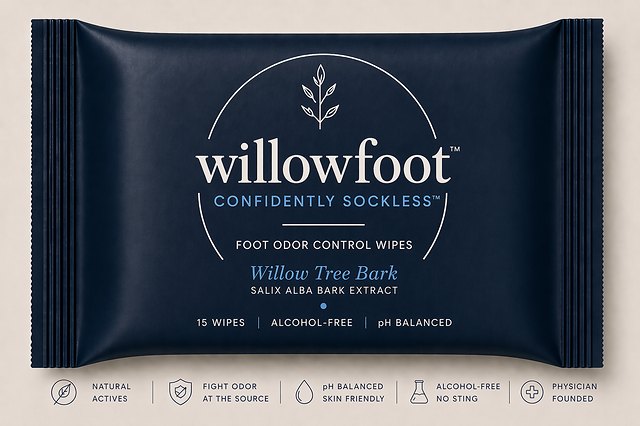
A three-layer routine.
Willowfoot's formula was designed to address the three things four millennia of research and trial-and-error suggest you actually have to do — without picking up the messes that the older formats came with.
Remove the food source
Willow bark extract delivers naturally-occurring salicin — a botanical glycoside long associated with gentle skin-surface care — helping clear away the dead skin cells that bacteria use as fuel.
Reduce the bacteria
Tea tree oil and witch hazel water bring familiar botanical character to the formula. Geraniol and citral — the terpene compounds documented in the 2006 Kanda research — round out a layer focused on the upstream source of the smell.
Neutralize the molecules
Zinc ricinoleate — a zinc salt of fatty acid from the castor bean — physically traps odor molecules already present, absorbing rather than masking. A trace of menthol delivers the cooling-fresh sensory cue.
What a wipe really is, up close.
Three layers of odor defense are the headline story. The rest of the formula does the equally important quiet work: keeping foot skin comfortable, hydrated, and the formula itself stable on the shelf.
- Aloe Vera
- Aloe Barbadensis Leaf Juice — a cooling botanical that softens application and supports skin comfort.
- Glycerin
- A humectant that draws moisture to the skin surface and prevents the dryness that makes lesser wipes feel harsh.
- Panthenol
- Provitamin B5, traditionally associated with smoothing and conditioning skin that has spent the day inside a shoe.
- Sodium PCA
- A naturally occurring component of the skin's own moisturizing factor; helps the foot retain moisture once the wipe has dried down.
- Coconut-derived surfactant
- Cocamidopropyl Betaine — a gentle, plant-derived cleanser, much milder than the surfactants used in older wipe formulas.
- Preservation
- A modern, formaldehyde-free preservative system based on phenoxyethanol and ethylhexylglycerin, supported by tetrasodium EDTA for stability.
- pH
- Adjusted with citric acid into the 4.5–5.5 range — the natural pH of healthy foot skin.
Willowfoot is a cosmetic personal-care wipe. These statements have not been evaluated by the FDA. This product is not intended to diagnose, treat, cure, or prevent any disease. The 2006 research referenced is: Kanda F. et al., "Foot odor due to microbial metabolism and its control," Canadian Journal of Microbiology (PubMed: 16699586).
Be first. Get 15% off your first order.
No spam. Just launch news and early offers.