Willow bark.
A 4,000-year story.
From Sumerian clay tablets to Hippocrates to your morning routine — how a quiet tree bark became one of the most influential plant extracts in human history.
It begins on a clay tablet.
The earliest recorded use of willow as a remedy is older than the alphabet. Sumerian physicians, in cuneiform tablets dated to roughly 2400 BCE, listed willow leaves and bark among their materia medica. Some seven centuries later, the Egyptian Ebers Papyrus — a sprawling 1550 BCE compendium of remedies — instructed practitioners to brew willow into infusions for fevers and aching joints.
By the 5th century BCE, the Greek physician Hippocrates was advising patients to chew willow leaves and drink its steeped bark. Around 50 CE, the Roman pharmacologist Dioscorides included willow in De Materia Medica, and Pliny the Elder noted its applications in Naturalis Historia. For more than two thousand years, willow was simply part of how people cared for the body — quietly, persistently, across the ancient world.
There was a hidden chemistry inside the bark — but no one yet had the tools to name it.
Three continents, the same instinct.
Hippocrates & Dioscorides
Greek and Roman physicians documented willow bark and leaf preparations in foundational medical texts. Hippocrates recommended chewed leaves; Dioscorides wrote up topical and infused applications in De Materia Medica — a reference still cited 1,500 years later.
Indigenous traditions
Many North American peoples — including Cherokee, Iroquois, and Plains nations — used native willow species for similar purposes. Inner bark was steeped, dried, or chewed. The knowledge predates written records and survived through oral tradition.
Monastery gardens
European monastic herbalists kept willow on their growing lists alongside chamomile, rosemary, and sage. It moved from materia medica manuscripts to local apothecaries — eventually reaching the bedside of an English clergyman who would change the story.
The molecule emerges.
For 4,000 years, willow worked. No one knew why. The breakthrough required the tools of modern chemistry — and a quiet succession of careful experiments across the 18th and 19th centuries.
-
1763
The Reverend Edward Stone’s report
An English clergyman writes to the Royal Society describing his trials with powdered white willow bark on parishioners suffering from ague. The first documented Western clinical observation of the plant’s properties.
-
1828
Salicin is isolated
German pharmacist Johann Buchner extracts a yellow, bitter glycoside from willow bark. He names it salicin, after the willow’s Latin genus, Salix. For the first time, the active constituent has a name.
-
1830
Crystalline purity
French pharmacist Henri Leroux refines the process and produces salicin in pure crystalline form — making it possible to study, dose, and replicate the compound with consistency.
-
1853 – 1899
From plant to laboratory
French chemist Charles Gerhardt synthesizes acetylsalicylic acid in 1853. Decades later, in 1897, Felix Hoffmann at Bayer produces a stable, scalable form. By 1899 it is registered as Aspirin — and the molecular descendant of willow bark goes worldwide.
It is one of the rare cases in human history where a folk remedy not only proved out — it gave rise to one of the most consequential pharmaceuticals ever made.
Willow bark’s second life.
Aspirin became the headline. But salicin — the original molecule — never left the personal-care world. Today, Salix Alba Bark Extract appears across modern cosmetic formulations, where it is valued for a different reason: how it feels and behaves on skin.
In topical use, salicin is described as a naturally derived precursor in the same family as beta-hydroxy acids — compounds long associated with gentle skin-surface care. Cosmetic chemists turn to willow bark extract when they want a botanical-leaning ingredient story, a mild conditioning feel, and a clean profile that pairs well with other plant actives.
It is, in other words, the rare ingredient with a 4,000-year resume — and a thoroughly modern role.
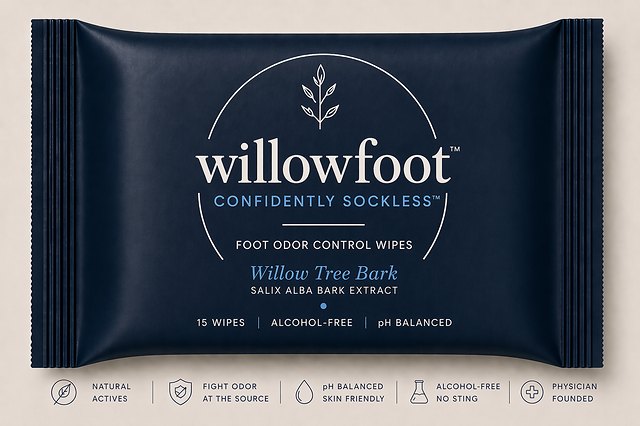
One ingredient, one quiet job.
When we set out to design Willowfoot, we wanted a hero botanical with a story worth telling — and a gentle, recognizable role on skin. Willow bark extract checked both boxes. It is the lead botanical active in Willowfoot’s foot odor control wipes, paired with tea tree oil and witch hazel for a clean, naturally-derived profile.
Our claim is small, on purpose: Willowfoot is a cosmetic personal-care wipe. The willow inside is not there to do what aspirin does. It is there to do what willow has always done — quietly, on skin, the way humans have used it for millennia.
Salix alba at a glance.
White willow (Salix alba) is a deciduous tree native to Europe, North Africa, and western Asia, growing readily along river banks and in wet soils. The bark — the part used cosmetically — is harvested from young branches and stems, ground, and extracted into a botanical liquid for formulation.
- INCI name
- Salix Alba Bark Extract
- Plant family
- Salicaceae
- Native range
- Europe, North Africa, western and central Asia
- Active glycoside
- Salicin
- Part used
- Young bark
- Cosmetic role
- Naturally-derived botanical active for skin-surface care; a beta-hydroxy-acid-related precursor associated with a clean, refreshed feel.
Willowfoot is a cosmetic personal-care wipe. These statements have not been evaluated by the FDA. This product is not intended to diagnose, treat, cure, or prevent any disease.
Be first. Get 15% off your first order.
No spam. Just launch news and early offers.